
How to Play The Major Scale in EVERY Key

This lesson is about transposing the major scale. Whether it’s Bb major or F# major, or A major, by the end of this lesson you will be able to play the major scale in any key you like.
We’ll be drawing heavily on what we learned in parts 1 and 2, so click here and here to brush up on those 2 lessons.
Since we’ve spent so much time in the open position, let’s start by learning a new position of C major scale that is easier to transpose into different keys.
The 3rd fret position
The 3rd fret position begins with the 2nd finger on the 3rd fret of the 5th string. For the most part the fingering is straightforward. On strings 3 though 6, your 1st finger plays all notes on the 2nd fret, 2nd finger plays all notes on the 3rd fret, and 4th finger plays all notes on the 5th fret.
Once you get to the 2nd string, you’ll shift everything up by one fret. So the 1st finger plays 3rd fret, 3rd finger plays 5th fret, and 4th finger plays 6th fret. Continue this fingering on the 1st string.
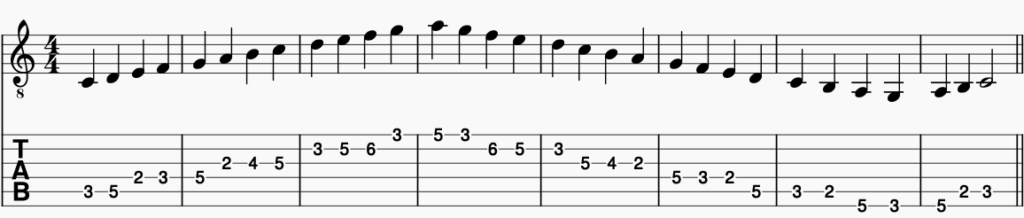
Once you complete the scale ascending, simply reverse the direction (using the same fingering), as shown in Fig.1, then keep going until you reach the lowest note in the position (G on the 3rd fret of the 6th string). Finally, return to the starting note (3rd fret, 5th string) to complete the exercise.
The reason we’re doing it like this is so you play all of the notes in the position, not just the ones that fall neatly between the tonic (3rd fret 5th string) and the octave (5th fret 3rd string). Practise this until you become confident with it, particularly that tricky shift at the 2nd string, which is often a sticking point for students.
PRO TIP:
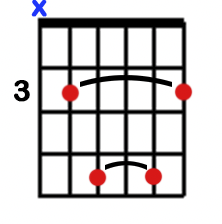
If you don’t have too much difficulty playing the C barre chord below (Fig.2), incorporate it into the Fig.1 exercise, similarly to what we did with the open C chord in the previous lesson. First play the chord (Fig.2), then play Fig.1, then finish with the chord again. This helps to anchor your ear into the sound of the chord. It also helps to connect the physical scale shape with a relevant chord in the same area of the fretboard. More on that concept later.
The Patterns
The next step is to get used to playing the notes of the scale in different orders. You can achieve this by practising patterns, and/or improvising. I recommend to do both, but let’s look at some patterns first.
In the previous lesson, we worked on 3 patterns in the open position:
1) The 123 Pattern
2) The 1234 Pattern
3) The Thirds Pattern
The next 3 exercises (Fig.3a, Fig 3.b, Fig.3c) are simply these 3 patterns in our new 3rd fret position of C major scale. If you have trouble understanding these patterns, there’s more detail in the previous lesson.

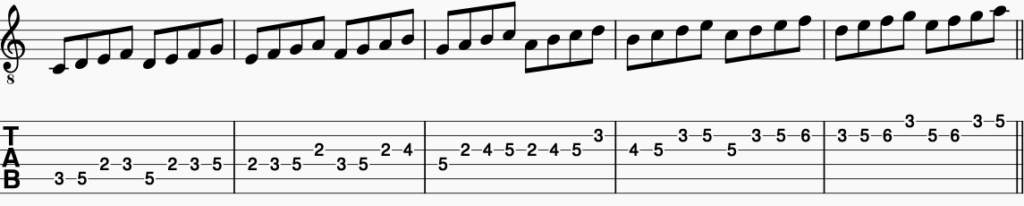
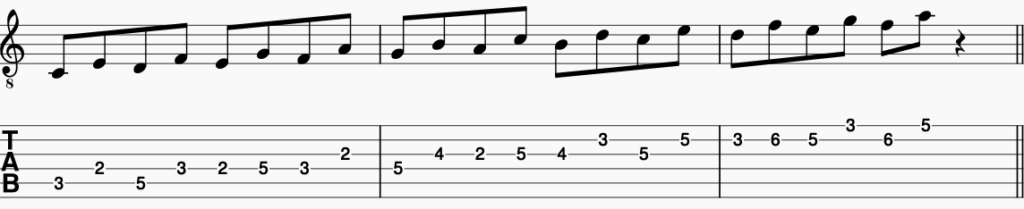
I recommend to practise these in the same way you practised the scale in Fig.1. First work on the ascending pattern (as shown in the above examples), then work on the same pattern descending. Go all the way to that low G (3rd fret, 5th string), then reascend to finish on the tonic (3rd fret, 5th string).
Transposing
Already we’ve covered enough for one lesson, but we haven’t even got to transposing yet! Fortunately the next part is quite easy… well it’s easy if you’ve mastered the material in the previous section and you have a complete understanding of how to name the notes on the guitar.
If you’re unsure how to name the notes, complete this lesson first before moving on.
D major scale
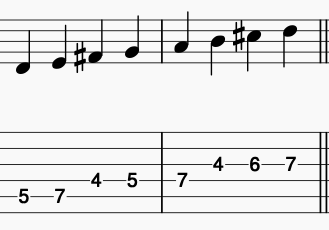
Going back to Fig.1, you can see that the first note of the exercise is the 2nd finger is playing a C note on the 3rd fret of the 5th string. This C note is the root note of the scale, meaning that we’re in the key of C and this note is a C. All you have to do to transpose Fig.1 into the key of D major is move that 2nd finger up 2 frets (5th fret, 5th string) and play the exact same shape. Here is one octave of D major scale below:
F major scale
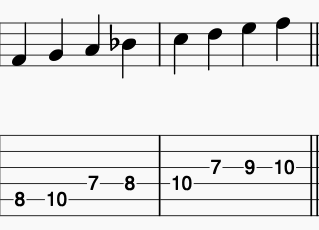
Let’s try another one a bit further away, how about F major scale? Using the music alphabet, you go up 2 frets from D (5th fret) to get to E (7th fret), then one more fret and there’s your F (8th fret) :
A major scale
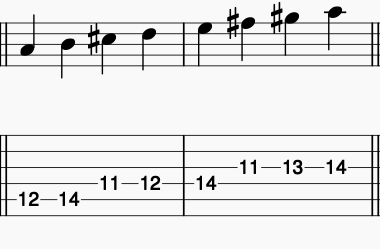
Let’s try one more – A major. We can’t actually play this shape with the open A as the root note, but we can go up the octave, place the 2nd finger on the 12th fret of the 5ht string and play the scale from there:
FROM SCALES TO MUSIC:
As mentioned earlier, the other way to get to know the notes (besides scale patterns) is to improvise. If you practise improvising with any material you’re working on, you’ll find that it becomes part of your musical vocabulary quicker.
The patterns are like learning fragments of language. Improvising is like using that language in a conversation. The goal of learning words and grammar is not to regurgitate learned phrases, but to communicate your own ideas to others.
To do this, limit yourself to a particular key and position. Next, start playing random notes in the scale. Incorporate fragments of patterns to give you a starting point of something to play. You could also limit the amount of strings you improvise on within the position, and then add more strings as you feel more confident.
Improvising is not rocket science, but it can feel intimidating when you first do it. I completely understand that feeling but like all things – the more you practise it, the more competent you become. So start now and you’ll reap the benefits sooner.